
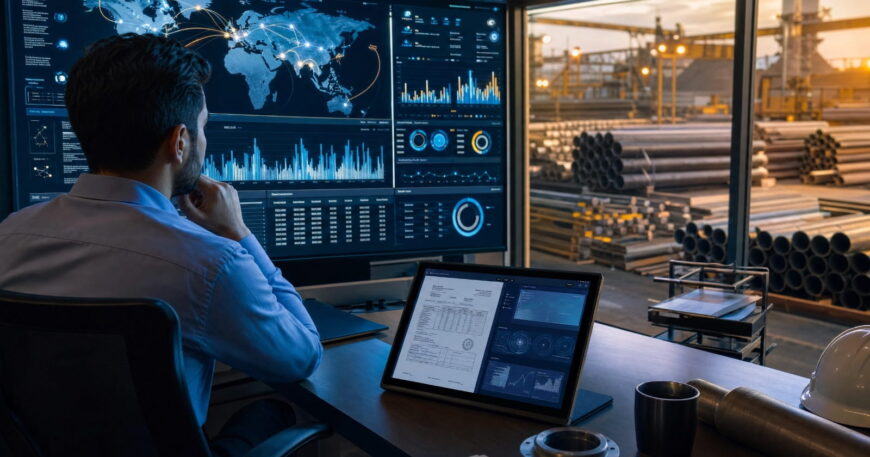
Every industry conference, every LinkedIn feed, every technology vendor is talking about AI transforming procurement. The promises are bold: automated supplier selection, predictive delivery forecasting, AI-powered quality inspection, and procurement teams reduced to a handful of people overseeing algorithms.
Some of this will happen. Much of it already is. But for industrial procurement where a wrong material grade can shut down a power plant and a missed inspection point can compromise structural integrity the conversation needs more nuance than “AI will replace everything.”
The real question is not whether AI will impact industrial procurement. It will. The question is: where does it create genuine value, where does it fall short, and what does this mean for how we source, inspect, and deliver industrial materials today?
Where AI Is Already Creating Value
Let us be clear AI is not a future concept in procurement. It is already operational in several areas that directly affect industrial supply chains:
1. Supplier Discovery and Pre-Qualification
AI-powered platforms can scan thousands of manufacturers, cross-reference certifications, analyse production capacity data, and generate shortlists of potential suppliers faster than any manual process. For initial vendor identification particularly in unfamiliar geographies this is genuinely useful.
But here is the limitation: AI can tell you that a manufacturer exists, holds an ISO 9001 certificate, and produces the right product category. It cannot tell you whether their shop floor matches their documentation, whether their quality culture is genuine, or whether they will prioritise your 50-tonne order over a 500-tonne order from a larger client. That still requires human assessment.
2. Document Processing and Verification
This is perhaps the most immediately impactful application. AI can:
- Extract data from Material Test Certificates and cross-check against purchase order requirements
- Flag discrepancies in dimensions, grades, or test values automatically
- Process hundreds of documents in minutes rather than hours
- Identify patterns in non-conformances across suppliers
For organisations handling large volumes of procurement documentation, this is not incremental improvement it is a step change in efficiency and accuracy.
3. Demand Forecasting and Inventory Optimisation
For MRO procurement and recurring material requirements, machine learning models can predict demand patterns, optimise reorder points, and reduce both stockouts and excess inventory. This works well where historical data is rich and demand patterns are relatively stable.
For project-based procurement where every order is unique the value is more limited. You cannot predict demand for a one-off power plant piping package based on historical patterns.
4. Logistics and Delivery Prediction
AI models that incorporate shipping data, port congestion metrics, weather patterns, and carrier performance can provide more accurate delivery estimates than traditional methods. For organisations managing multiple shipments across global routes, this visibility is valuable.
Where AI Falls Short – For Now
Industrial procurement is not e-commerce. The materials are complex, the specifications are critical, and the consequences of error are severe. In several areas, AI remains limited:
Physical Inspection Cannot Be Fully Automated
AI-powered visual inspection systems exist and they work well for repetitive, high-volume manufacturing (electronics, automotive components). But for industrial materials where every pipe heat is different, every forging has unique characteristics, and inspection criteria vary by project specification fully automated inspection is not yet reliable enough for critical applications.
The human inspector, supported by better tools and data, remains essential. AI can assist (flagging anomalies in NDT data, automating dimensional measurement comparison), but it cannot replace the judgement required for complex industrial inspection.
Relationship and Trust Cannot Be Algorithmised
Industrial procurement operates on relationships. A manufacturer who prioritises your urgent order because of a long-standing relationship. A supplier who flags a potential specification issue before production begins because they understand your project context. An inspector who knows which areas of a particular factory require closer attention.
These relationship-driven behaviours built on trust, experience, and mutual understanding are not replicable by algorithms. They are, however, enhanced by better data and communication tools.
Context and Judgement Remain Human
When a material test result falls marginally outside specification, the decision to accept, reject, or request re-testing requires engineering judgement, project context, and risk assessment. AI can flag the deviation. It cannot make the disposition decision — at least not for critical industrial applications where the consequences of a wrong call are measured in safety incidents, not customer complaints.
The Practical Path Forward
For industrial procurement organisations whether you are an EPC contractor, a project owner, or a supply-chain support company like NASQS the practical approach to AI is neither wholesale adoption nor dismissal. It is selective integration where the value is proven:
Automate the administrative, augment the technical, preserve the relational.
- Automate: Document processing, data extraction, compliance checking, routine reporting, supplier database management
- Augment: Inspection data analysis, supplier performance tracking, risk scoring, delivery prediction, specification cross-referencing
- Preserve: Vendor relationships, engineering judgement, inspection decision-making, project-specific coordination, client communication
This framework ensures that AI enhances procurement capability without introducing the risks that come from over-automation in high-consequence environments.
What This Means for Choosing a Procurement Partner
As AI tools become more accessible, the differentiator between procurement partners will not be who has the most advanced technology it will be who integrates technology most effectively with human expertise.
Look for partners who:
- Use digital tools to improve documentation accuracy and processing speed
- Maintain human oversight for inspection decisions and quality judgements
- Leverage data for better supplier performance tracking and risk management
- Invest in communication systems that provide real-time project visibility
- Combine technological capability with industry experience and relationship depth
The best procurement partners in the AI era will not be those who replace human expertise with algorithms. They will be those who use AI to make their human expertise more effective, more consistent, and more scalable.
The NASQS Perspective
At NASQS, we view AI and digital tools as enablers not replacements for the technical expertise and coordination capability that industrial procurement demands. We invest in systems that improve our documentation processing, supplier tracking, and communication efficiency. But we maintain human expertise at every critical decision point: vendor assessment, inspection coordination, quality judgement, and client engagement.
Our approach is practical: adopt what works, maintain what matters, and never compromise on the human judgement that complex industrial projects require.
The future of industrial procurement is not AI versus humans. It is AI-augmented humans delivering better outcomes faster, more accurately, and with greater visibility than ever before.
Key Takeaway
AI is reshaping industrial procurement but not in the way most headlines suggest. The real transformation is not about replacing procurement teams with algorithms. It is about augmenting experienced professionals with better tools, better data, and better systems — so that human expertise can focus where it matters most: judgement, relationships, and complex decision-making.
Want a procurement partner that combines technical expertise with modern capability?
Talk to NASQS about how we deliver quality-assured procurement with the efficiency and visibility that today’s projects demand.